God's Holy Word

Chapter One
Chapter Two
Chapter Three
Chapter
Four
Chapter Five
God's Holy Word
Of all the subjects there are to study there is none as
essential to one’s faith as the study of God's Word itself. For without God's
Word, there would be no faith, as Romans 10.17 states:
"So then faith cometh by hearing, and hearing by the Word of
God".
The Bible consists of sixty-six books; thirty-nine in the Old
Testament and twenty-seven in the New Testament. In those books, there are 1,189
chapters, 31,101 verses, and 628,652 words. All of this is considered in respect
to the King James or Authorized version.
The Word Bible comes from the Greek word biblion which
means a scroll or a little book. The word Testament comes from the Greek word
diatheke (gk) which is translated covenant or agreement; it is a compound
word that literally means:
dia
- through
theke- a box
Thus, Christ came through the box, or the Ark of the
Covenant, in which was contained the tablets of the law. Hence, Christ came to
fulfill the law not to abolish it (Matthew 5.17).
There were more than thirty-five penmen who wrote the books
of the Bible. Yet, there was only
one author: God. The term penmen differs from the word author because an author
thought of and seeks to convey his thoughts and principles in written form.
In the case of the Bible, God has revealed Himself and His principles to
us in written form through the Bible.
God used more than
thirty-five different penmen, those who actually penned the letters, words and
sentences to write it all down. This
is referred to as inspiration and will be discussed in the next chapter.
The Old Testament was primarily written in Hebrew except for
parts of Ezra, about six chapters of Daniel, one verse in Jeremiah, and two
words in Genesis which were written in Aramaic. The New Testament was written in
Koina Greek, the common language of the people. Later, when the common language
of the people became Latin the Bible was translated into what is commonly called
the Latin Vulgate and has now been translated into many different languages.
In some languages though it has been translated many conflicting times.
The modern chapter and verse divisions first appeared in the
Latin Vulgate (1555 AD) and in the English Geneva Bible (1560). Keep in mind
that the Bible was originally written by hand in the form of letters without any
divisions. Our modern divisions help us find parts of the text quickly but often
interfere with the context of the message. Try to avoid the tendency to
partition the text for it will often make more sense when it is kept together.
When the Bible was translated, there were occasions when
words had to be added to the text in order to make the language more
understandable. In many translations, there is no way for the average individual
to identify these additions. However, the translators of the Authorized King
James Version were very careful to place these additions in italics for
easy identification.
Since our Bible was originally divided into numerous
different books, when and how were they brought together? Basically, both the
Old and New Testaments went through a process we call canonization; they were
carefully scrutinized and tested to ensure that they were indeed God's Word
before they were accepted into what we now call our Bible. Since the Old
Testament was handed down to us, for the most part intact, we will focus in on
the New Testament.
The first New Testament books to be assembled were the
Epistles of Paul. Peter indicated that this collection had at least begun when
he wrote:
"And account that the long-suffering of our Lord is
salvation; even as our beloved brother Paul also according to the wisdom given
him hath written unto you; as also in all his epistles, speaking in them of
these things; in which are some things hard to be understood, which they that
are unlearned and unstable wrest, as they do also the other Scriptures,
unto their own destruction." (2 Pet 3.15-16).
There were many other works that tried to make their way into
the New Testament canon, but by the fourth century, the twenty-seven books we
now have were, and have been, the only ones recognized by the Church. All others
have been rejected.
The Testimony of God
Often we leave out the most compelling and enlightening
evidence of the purity of God's Word. What is this overwhelming evidence? It is
the very Word of God itself. So, let’s focus for a few minutes on what the Bible
claims about Scripture.
First and foremost, we must understand the importance of a
proper understanding, or perspective, of God's Word. Our stand on God's Word is
so very important because it is the very source of our FAITH; as Romans 10.17
reveals:
If this Scripture is correct, then there can be no faith
apart from God's Word. No wonder Peter wrote:
"As newborn babes, desire the sincere milk of the Word, that
ye may grow thereby:" (1 Peter 2.2).
So, how can a new Christian know without a doubt that this
Bible really is God's Word, final in its content, inerrant in its text, inspired
in its writing, and fully able to be trusted down to its last letter?
The most compelling reason is given in its very text.
God gave His Word to mankind through a process called in the
Bible inspiration; this is declared in 2 Timothy 3.16,17:
"All scripture is given by inspiration of God, and is
profitable for doctrine, for reproof, for correction, for instruction in
righteousness: That the man of God may be perfect, thoroughly furnished unto all
good works".
The Greek word for
inspired is theopneustos (gk) which is a compound word that
literally means God inspired. It finds its root in the Greek word pneo (gk)
meaning to breath. Thus we find that
as the penmen were writing the Bible, God was breathing His Word out to them
through the Holy Spirit. This
pictures a boss dictating a letter to his secretary.
Some scholars fervently object to the idea of dictation when
it comes to the Word of God. They
say the individual styles of the different penmen is apparent in their writings,
something that would not exist if dictation was involved.
However, God is greater than a boss in that God knew the writing styles
of each penman when He selected them.
Therefore, it is possible and probable that God incorporated their
writing styles in His text when He breathed it out to them.
Another Scripture that speaks of the way the Scriptures were
given is 2 Peter 1.21, which states:
The Greek word for moved here is pherumenoi (gk)
meaning to move or to bear or carry.
It has been described by some scholars as a nautical term used to speak of a
sailing ship at sea that has lost its helm, and though it is still afloat and
still sailing, it is subject to the winds and currents for its actual direction.
Thus, God moved the penmen of His Word to write as He desired that they write.
It expresses that the Holy Spirit actually carried or moved the penmen of the
Bible as they wrote so that, in essence, one could easily state that God wrote
through them. Thus, God Himself claims this Bible to be His Holy Word.
This is all well and fine, but how do we know that what we
have is indeed God's Word? How do we know that man has not changed or corrupted
it? As far as the preservation of God's Word is concerned, He has said:
" The grass withereth, the flower fadeth: but the Word of
God shall stand forever" (Isa 40.8).
Jesus said "For verily I say unto you, till heaven and
earth pass, one jot or one title shall in no wise pass from the law, till all be
fulfilled" (Matt 5.18).
"Heaven and earth shall pass away, but my words shall not
pass away" (Matt 24.35).
"But the Word of the Lord endureth for ever. And this is
the Word which by the gospel is preached unto you" (1 Pet 1.25).
How much clearer could God be. He intended for His Word to
last throughout the ages. Now there are some that would say, “Sure He did, but
then man got his hands on the document and man has corrupted God's Word.”
And my reply is simple: yes, man has indeed tried to corrupt God's Word
in his attempts to make it better (many translations), however, God has kept His
Word (the Greek Textus Receptus) pure through the ages and will continue to keep
His Word pure.
There are only a few questions that need to be answered to
prove this point. Is God able to keep His Word, if He desires to do so? Well, of
course God is able; if He wasn't He wouldn't be God. And then, does God desire
to keep His Word pure? According to the Scriptures given above, not only does He
desire to keep His Word, but He literally promises to keep His Word perfect for
every generation and into eternity.
Consider for a moment, if you will, that there has always
been God's Word, and then there has been Satan's mutilation of God's Word. They
have always coexisted, and will coexist until God finally judges this world we
live in. Satan in the garden of Eden tempted Eve with a mutilation of God's
Word. When Jesus was in the wilderness to be tempted, Satan tempted Him with the
mutilation of God's Word. So, why are we so slow to recognize that Satan even
now tempts us with his mutilation of God's Word. Don't be ignorant of our enemy,
and his crafty works. Realize what
the testimony of history is and what the testimony of God's Word is and react
accordingly.
Many Manuscripts
In respect to God's Word, the Holy Bible, there is no
controversy as predominate as that surrounding the many versions of the Bible.
Some claim that there is no inerrant, authoritative Word of God in the English
language while others claim that there is indeed a Word of God providentially,
omni-potently kept by God's divine influence and will. Others will use the words
infallible and inerrant to describe God's Word, yet, when pressed, will have to
admit that they are only speaking of the original autographs and will say that
we do not have an accurate copy of those autographs today. I disagree! God said
He would keep His Word, and I am convinced that He indeed has.
It will be the scope of the remainder of this text to
diligently study the facts surrounding this controversy. This study, due to a
lack of space and time, will not attempt to discuss all of the different
versions in circulation today, but will focus on those that appear to be the
most widely used at this time: the King James (Authorized) Bible, and the New
International Version. For the sake of this study, we will focus primarily on
the New Testament text with occasional comments on the Old Testament. For a more
in-depth study of this subject, a book list will be included at the end of this
study.
At the very core, or heart, of this subject there is the
controversy over the available manuscripts that exist today. According to Prof.
Kurt Aland, “Only 3 Unicals (A 01, A 02, C 04) and 56 minuscules (or 57, if
205abs is counted separately) contain the whole of the New
Testament.”1 There are
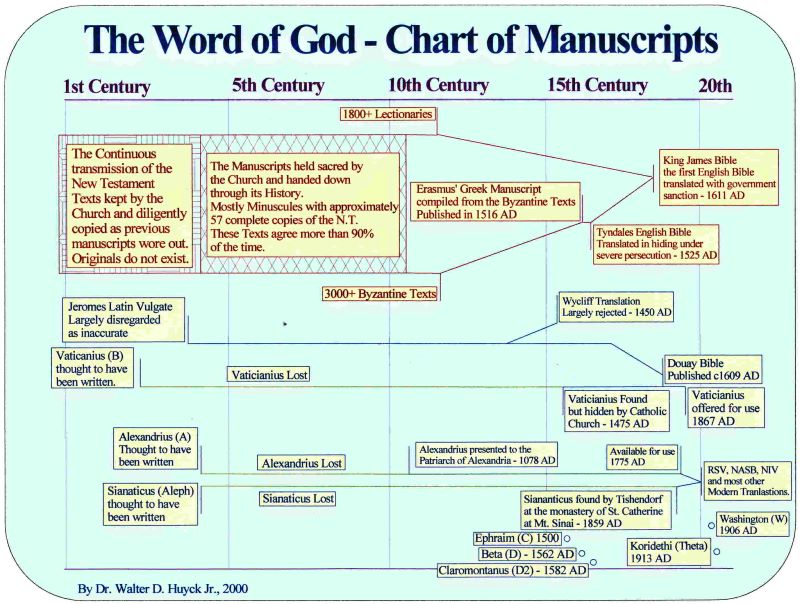
3,112 manuscripts that survive today; most of them are fragmentary. Of these,
there are 81 papyrus manuscripts, 267 majuscules (written in capital letters),
and 2,764 minuscules (written in small letters). Of these manuscripts, 97
percent of them agree with the Greek text used to translate the King James
Bible. Keep in mind that these numbers may be approximate. Of these manuscripts,
approximately 3,000 are classified as Byzantine Texts, of which texts the Textus
Receptus has been compiled.
Of the manuscripts, other than those considered Byzantine,
there are only three that are considered nearly complete and approximately eight
to twelve partial manuscripts available. The Codex Vaticanus was written in
approximately the 4th century and kept in the Vatican Library at Rome. Its first
historical record was in 1475, and where it came from is not known. The Vatican
had not allowed anyone outside of the Roman Church to even view the text until
the near recent past (c. 1867). The Codex Sinaiticus was discovered by
Tischendorf in 1859 at the Monastery of St. Catherine on Mount Sinai. It was
given to the Czar of Russia and then sold to a British Museum in 1933.
It is said to have been written in the late 4th century. The Codex
Alexandrinus was written in approximately the first part of the 5th century and
was given to the King of England in 1627 by Cyril Lucar.
Since 1775 it has been kept in a British Museum. An interesting aspect of
these non-Byzantine texts is that they almost never agree with one another.
There is one other text that has been at the center of the
scholarly debate since the debate began.
It is called the Textus Receptus, but it is sometimes referred to as the
Received Text, The Traditional Text, or the Majority Text. It is not a single
Greek manuscript but is a compilation of the many texts that were available to
the Church throughout its history. A large portion of this text is referred to
as the Byzantine Text due to the fact that it was compiled from those
manuscripts that survived the Byzantine period.
Edward Hills dates this period between 312 and 1453 AD.2 These
texts are recognized as the only texts to have existed with the Church
throughout its history and remain available to the Churches today. Of the
Byzantine Texts, there are Fifty-Seven complete New Testament copies.3
Some of these manuscripts are said to be as old as the 4th or 5th century. One
important aspect of the Byzantine manuscripts is that they almost always
agree and where one manuscript may become obscure, there are a multitude
that fully agree and give an accurate, supportive witness to the original text.
The Textus Receptus is the result of the diligent work of
Desiderius Erasmus (1466-1536), Robert Stephanus (1503-1559), John Calvin
(1509-1564), Theodore Beza (1519-1605), and the Elzevir Family (c. 1600-1640).
The second edition of the Greek New Testament published by the Elzevir
family in 1633 was the first to use the term Textus Receptus in it preface.4
While there were various editions of this Greek New Testament throughout
its compilation, the variations between these editions were minimal and could
virtually be listed on two pages of this text, which is astounding when
considered in light of the entire New Testament.
It is important at this point for Christians to realize that
the three oldest manuscripts available to the Church today have not always
been available to the Church. As a matter of historical fact, any one of
these manuscripts were not available until 1475 AD at the earliest, but we know
that the Roman Church did not allow access to their text. The next to it was not
available, according to the historical record, until 1627 AD. However, the texts
that compose the Majority Text were always available and accepted by the
Church. Also, keep in mind that what are often called the oldest manuscripts
available only out-date the Majority Text by less than one hundred years.
Textual Criticism
Wescott and Hort used as their primary argument that the
Bible is like any other antiquated text and should be treated in its translation
like any other ancient text. Thus,
they pushed aside every other text (98% of the texts now available) and used
what they considered to be the most reliable: the very oldest texts. Miller
notes, “Such are the views of Westcott and Hort.
Rejecting the great mass of authorities, they relied upon a relatively
small group of early uncials and versions, with a few later manuscripts which
have the same type of texts.”5
Miller goes on to note that other scholars argued “That the 5 or 6
ancient manuscripts [used by Westcott and Hort] are in perpetual disagreement.”6
Hence, Wescott and Hort pushed aside 98% of the existing manuscripts that
agreed with each other 90 to 95% of the time in their content, to use 5 or 6
manuscripts that seemed to rarely agree with each other.
This would be like standing in a court of law under trial.
When the witnesses are marched in, 100 in all, ninety-five of them almost
agree word for word in their testimony, and only five have different stories
that do not even agree with each other.
The prosecutor argues that the five disagreeing witnesses should be
trusted more than the other 95 for some incomprehensible reason.
Who would you believe? Who
would you hope the jury and judge would believe?
The difference here is that in the case of New Testament
Manuscripts, there are over 3,000 texts represented in the form of the Textus
Receptus. These texts almost always
agree, of which there are 57 complete copies of the New Testament.
These are placed in the balance with no more than six manuscripts,
recently discovered, that rarely agree.
These six are referred to in modern scholarship as the eclectic texts or
the best texts.
Keep in mind that when the translators of our modern versions
and editors of our study Bibles use the term eclectic to describe the manuscript
they used, they are saying that they used the very best text available in their
opinion. In almost every case, that
indicates that they are pushing aside 98% of the manuscripts available and are
classifying a couple of very old texts that were not available to the Church as
a whole until 1600 or 1700 AD and almost never agree with each other as the very
best. As a matter of fact, this modern theory pushes aside all but maybe three
manuscripts that for all practical purposes never agree with each other. This
was the view of Wescott and Hort and is the view that is being taught in most of
our seminaries today.
Is The Oldest Best
Modern Translations
So, how do these Greek manuscripts affect our modern
translations? Only three English translations utilized the Majority Text in
their translation: The King James (Authorized) Bible, the Revised Standard
Version and the American Standard Version. Two of these have been rejected
through the process of time, though they are still found in use in some very
remote places: the Revised Standard Version and the American Standard Version.
All of our most recent and most highly acclaimed translations have abandoned the
Majority Text completely for one of the three older manuscripts, claiming
them to be the best. It is interesting to note that for the Old Testament, they
claim to leave the traditional texts for the texts commonly called the Dead Sea
Scrolls. The problem is that the
Dead Sea Scrolls do not in any way oppose the traditional Old Testament texts,
yet there are changes that have been made.
Now, there are those who would claim that even though there
are changes from one text to another, that those changes do not damage or hinder
any of the major doctrines of the Church. This is indeed a ridiculous claim and,
in a latter chapter, will be examined in brief detail. The fact is that God has
promised to keep His Word for us, and our faith stands wholly upon His Holy
Word; any change injects question into its reliability and attempts to destroy
the foundation of one’s faith.
The truth of the manuscripts is commonly unknown to the
average Church member, and the true heart of the conflict is even less realized.
It is the common acclamation of the proponents of these newer versions that
there is no inerrant Word of God. They make comments like “the Scriptures
are not inerrant in context, but are inerrant in spirit.” They claim that since
there are no original autographs remaining, that it would be ridiculous to think
that man would not have corrupted the text.
However, there are some basic problems with their view.
First, if there is no authoritative, inerrant Word of God available today, then
where does one find his or her faith? Perhaps their definition of faith is not a
Scriptural one. Next, if the manuscripts that have been found in recent years
are more accurate than those of our forefathers, then the Church of our
forefathers could not have had an authoritative Word.
So, how could they find the overwhelming faith to bring this Church
through the dark ages?
It becomes apparent that there are some compelling facts that
challenge the modern study of Greek Manuscripts:
The Authorized Bible
The Translators
Advocates of the modern versions often assume that they are
the product of scholarship far superior to that of the translators of the King
James Version of 1611, but this assumption is not supported by the facts. The
learned men who labored on our English Bible were men of exceptional ability, .
. . To them it was "God’s sacred Truth" and it demanded the exercise of their
utmost care and fidelity in its translation.1
Each company was given a section of Scripture to translate,
and then sent their work to the other companies for evaluation and suggestions.
After the Bible was completed, it then passed under the scrutiny of six to
twelve of the leading scholars for revision.
As far as their materials were concerned, there was:
The Scholarship
Of the members of this first group, it is interesting to note
that Saravia was not a native Englishman; "his value to the company of which
he was a member lay less in his ability to turn the Bible into English than in
his general linguistic skill, for which he was famous"5. Bedwell
is attributed with being the Father of Arabic studies in England. This first
group was tasked with the Old Testament from Genesis to Kings.
The second company at Cambridge, assigned with the Old
Testament from Chronicles to the Song of Solomon, consisted of Edward Liveley,
John Richardson, Lawerence Chaderton, Francis Dillingham, Thomas Harrison,
Rodger Andrews, Robert Spalding, and Andrew Byng: eight in all.
All are attested to be Cambridge men.
Of this group, Edward Lively died in 1605 during the
preliminaries of the translation; Spalding succeeded him. Chatterton was a
puritan and the first head of Emmanuel College; it is said that he lived to the
age of 103 in an amazing state of health, not even needing the use of spectacles
to read his Greek New Testament. Dillingham was a Greek scholar and even debated
in Greek, against the customs of the day. Harrison was another known Puritan,
and Rodger Andrews was the brother of Lancelot.
The third company was responsible for translating the
remainder of the Old Testament and met in Oxford. It consisted of John Harding,
John Reynolds, Thomas Holland, Richard Kilbye, Miles Smith, Richard Brett, and
Richard Fairclowe: seven in all. Reynolds, an extreme Calvinist, was probably
responsible for the inspiration of the whole project when he commented on the
need for a version acceptable to all parties. Reynolds never saw the end result
of the project for he died in 1607 at the age of fifty-eight. Holland also died
soon after the translation was completed. Miles Smith was a Puritan and authored
the translator's preface for the work.
The forth company was entrusted with the translation of the
Gospels, Acts, and the Revelation of John. It met at Oxford and consisted of
Thomas Ravis, George Abbot, Richard Edes, Giles Thompson, Henry Saville, John
Perin, Ralph Ravens, and John Harmar. When some of this company’s members
resigned, they were replaced with Leonard Hutton, and finally James Montague.
Edes died in 1604 as did Ravis in 1609 after becoming the Archbishop of
Canterbury. Thomson was a royal chaplain of the Most Noble Order of the Garter
and is said to have been extremely diligent in translating the text. Abbot was
attributed with being greatly responsible with the union of the English and
Scottish churches. Savile was a Greek tutor to Queen Elizabeth and had
established quite a reputation as a Greek Scholar.
The fifth company, tasked with translating the remainder of
the New Testament, met at Westminister and consisted of William Barlow, Ralph
Hutchinson, John Spencer, Roger Fenton, Michael Rabbett, Thomas Sanderdon, and
William Dakins: seven in all. Barlow was the Bishop of Lincoln.
Although the Apocrypha is not contained as a part of the
authorized version, the whole sixth company was tasked with its translation.
This company met at Cambridge and consisted of John Duport, William Brainthwaite,
Jeremiah Radcliffe, Samuel Ward, Andrews Downes, John Boys, and William Ward. Of
these John Bois is reportedly the most extraordinary. He could read the Hebrew
Bible at the age of six, and write the Hebrew alphabet with elegance when he was
just a boy; he not only worked with the sixth company but also assisted the
second and worked on the general revision.
After its completion, the resulting text is given this
testimony:
Publication
Another fact that is often neglected when considering the
translation of the Authorized Version is that these translators were not only
amazing in their abilities, but their preparation was just as incredible. These
men used the available and accepted Greek, Latin, and other materials commonly
used in translational work. This was
not simply a bunch of theological graduates coming together with a few years of
study under their belts. These men were veterans of the Word of God not
just in the language of their day, but in the languages of the available texts
of their day.
This document does not have enough room or time to do these
great men of God due justice. It
supplies only a taste of the weight of their ability for the task they
accomplished. After surveying these men and their credentials, it is this
author's opinion that God indeed rose these men up for the sole purpose of
translating God's Word into English, and by God's hand He has indeed kept His
Word intact for us today: a standard for our faith.
As amazing as it may seem in our day, an American edition of
this Bible was issued in 1782 after it had received congressional endorsement.
Of the grandeur of the Authorized Version we have this testimony:
The Other Versions
The primary focus of this chapter is to deal with some of the
differences between the Authorized (Majority Text) Bible and most of our
newer translations, which abandoned the majority of texts for the sake of a
couple of older texts. For the purposes of this study, we will focus in on the
New International Version in comparison to the Authorized Bible, since this is
the most accepted translation of our day.
Most of these newer translations claim to have followed a
similar approach in their translational process as that of the King James Bible.
However, while their process seems to have been forth-coming and honest, there
are some omitted facts that ominously hang over their translation as a
mysterious cloud of secrecy. For example, the Authorized Bible was translated
through the process of committees.
Of these committees, an overwhelming amount of information is available.
We know who was on each committee, we know each of these men's
credentials, we know where the committees met and how often.
We know the circumstances of each committees debate over their
translational process. We know these
things because everything was done publicly.
In comparison, the New International Version (NIV) claims to
have been translated by a corps of scholars of various denominations brought
together from around the world. However, no one can seem to name even one of
these scholars. Who were they? What were their credentials? We don't know how
many teams of scholars were used in the translational process. We don't know
what translational process was used. Nothing appeared to be done publicly, so no
one can scrutinize the actual debating process that was used.
In the preface of the NIV itself, there is not even a clear indication of
which manuscripts were used in the process of the translation; it just states
that an eclectic text was used. By
the way of reminder, eclectic simply means the best. But the best in whose
opinion?
The questions go on and on.
There is no doubt about the mystery that shrouds the NIV and almost every
other modern translation available today.
The New King James Version is deceptive to its very core. Its very name
seems to imply that it finds its roots in the same text as the King James
(Authorized) Bible. However, the fact is that its translators also abandoned the
Majority Text and used the older Alexandrian Text. It is not an updated
Authorized Version; it is a new translation from beginning to end.
Textual Changes
Consider 1 John 5.6-8.
The NIV literally drops out the whole of verse seven and places it in a
footnote with a disclaimer to the effect that this verse was not in the oldest
manuscripts. Any scholar knows the controversy of this verse and also knows that
the Church fathers found it credible and therefore endorsed it as Scripture. To
drop this verse is a direct attack on the Godhead. For the average reader, the
missing verse will never be noticed. They will read the passage in the NIV and
never realize that one of the strongest verses lending support to the trinity is
not even in their text.
Another series of Scripture that is directly attacked is that
of Mark 16.9-20. While the passage is still displayed, there is a prominent note
attached to the text which states "The most reliable early manuscripts and other
ancient witnesses do not have Mark 16.9-20", which attacks the credibility of
the passage. Some of the other modern versions just drop this passage
altogether. This brings us to another viable and unanswered question: what are
these other ancient witnesses? It should raise a question in your mind when a
modern scholar will drop a whole passage of scripture on the authority of two
manuscripts when there are fifty-seven complete New Testament manuscripts that
present the passage in almost complete agreement.
Consider the passages that pertain to our Lord's prayer
Matthew 6.9-15 and Luke 11. 2-4; there are dramatic changes to the text at this
point. Other omissions and changes are numerous and often undetectable. For
instance compare the differences in the following verses:
Matt 17.21;23.14; Mark 7.16; 9.44-46; 11.26; 15.28; Luke
17.36; 23.17; John 5.4; Acts 8.37; 15.34; Rom 16.24
These are just a few examples of textual corruption.
Actually, the differences are in almost every passage throughout the Bible.
If one were honestly interested in finding the differences, one could
literally find and catalogue the differences in every passage.
Which Bible
Just what is the importance of this whole debate? Could it
possibly affect my beliefs? Won't the Holy Spirit keep me from going astray?
Consider these facts. First, God has indeed promised to keep His Word until His
coming; therefore, we know that God's Word is available. Since the beginning of
time, Satan has challenged God's Word with a corrupt approximation of God's
Word. When Jesus was tempted in the wilderness, Satan tempted Him with Scripture
(Matt 4.1-11). Eve was tempted with a corruption of God's Word all the way back
in the Garden of Eden (Gen 3.1-5). Don't be deceived my friend; Satan has always
presented a corruption of God's Word to this world, to this Church and even to
God Himself in an attempt to misguide God's chosen people and to challenge God's
purposes and plans.
According to Romans 10.17, your faith, the very foundation of
your Christianity, hinges on God's Holy Word. That being the case, God would not
allow His Word to be corrupted. God is greater than mankind and Satan and has
indeed providentially kept His Word pure and trustworthy for your sake. If there
are two books that both claim to be God's Word and they both say something
different, even if its is only one Word that is different, then one of them must
be wrong, and God is always right. Seek, find and trust only God's Word. Your
Christianity hangs in the balance for the importance you place in God's Word
will indeed manifest itself in your Christian walk and life for years to come.
Some would accuse me of just being too closed-minded and
hard-lined. I am convinced that we
have an accurate copy of the original manuscripts.
It is presented in the "Received Text" of the Greek New Testament. God
raised up over forty-eight amazing men to translate His Word into our language.
Is it the ultimate translation of God's Word?
The fact is that no translation could be as accurate as the original
manuscript; hence, the answer must be no.
However, the King James Version is the best possible English translation.
Our modern scholars are sincere in their efforts, but we must acknowledge that
they just are not as qualified as those scholars that translated the King James
Bible. It is equally as obvious that the materials being used are not as worthy
as the texts that the Church has always possessed.
Translational Methods
While some modern translations seek to be literal in their
translation, many depart from a word-for-word format.
The NIV seeks to translate the Bible at the level of the thought of a
context. Hence, some sentences only
remotely resemble the original Greek text.
Other translations are paraphrases, like the living Bible and the
Message, which endeavor to present
the message of a whole passage as it is perceived in the minds of the
translators. Whole pages of the
Bible will remotely resemble the original Greek text in these cases.
While the intention of these translations seem noble, their
result is very anti-theological.
Why? Because God was clear about the
level of integrity that should be maintained in regard to His written Word.
Consider these passages:
Deuteronomy 4:2 Ye shall not add unto the
word which I command you, neither shall ye diminish ought from it,
that ye may keep the commandments of the LORD your God which I command you.
Matthew 5:18 For verily I say unto you, Till
heaven and earth pass, one jot or one tittle shall in no wise pass from
the law, till all be fulfilled.
It is apparent that God intended for every word in His
revealed Word to remain intact.
Jesus took the level of integrity in God’s Word to the level of a cross on a “t”
or the dot on an “i”. God wanted His
Word persevered with meticulous integrity.
This extreme attention to detail has been the witness of Jewish scribes
throughout the History of Israel.
The transmission of God’s Word was of the highest regard for Jewish scribes.
They were meticulous that no error, not even the slightest one, would
find its way into the Biblical text.
Why is this level of detail so important?
First, Because the interpretation of God’s Word is the work of the
Holy Spirit within the heart of each individual believer.
It is the Holy Spirit that reveals the deep things of God within us (1
Cor 2. 9-16). No other human being
can enlighten the Word of God for us as dynamically as the Holy Spirit can.
When one man, or a committee of men, presume to impose their opinions of
the Word of God upon us by rewriting the Word of God, then they rob their
readers of the illuminating work of the Holy Spirit.
Second, the Word of God consists of multiple levels of
spiritual impact upon its readers.
There is the Milk of the Word, and then there is the Meat of the Word
(Heb 5.12-23). When any translator
presumes that he or she can convey the thought presented by a particular
scripture, are they conveying the milk or meat of the Word?
For any mere mortal to think that they can covey both the milk and the
meat of the Word in a single thought as effectively as Almighty-God must reveal
the highest kind of pride and presumption.
It seems very clear that the only real means of translating
the Word of God into any other language must be literal and word-for-word with
clear indications of any mortal additions.
This is what the King James translators did.
Anything else should not be regarded as the Word of God and should not be
referred to as the Bible. Instead,
these should be identified as what they are: mere commentaries about the Bible.
Unfortunately, in our day, this is not the case; they are presented and
sold as the Word of God.
I look at the new translations as nothing more than your
average commentary. Some of them are very corrupt and unreliable.
Others are more trustworthy. I often wonder why faithful and sincere
Christians would trust their spiritual well being to some commentary about God's
Word, treating it as though it is God's Word while it is literally dropping
verses and passages from its text. The translators place notes in the margin
informing the reader of their omissions, but how many average readers really
read the margins and footnotes in their Bibles? If you are truly interested in
reading God's Word, then I will refer you to the Received Text in Greek and its
most accurate translation in English, the King James Bible.
Conclusion
Endnotes
All Scripture references are quoted from the Authorized
Version.
Chapter Three
1Kurt Aland and Barbara Aland, The Text Or The New
Testament: An Introduction To The Critical Editions And To The Theory And
Practice Of Modern Textual Criticism, (Grand Rapids, William B. Eerdmans
Publishing Co., 1987), Pg 78.
2 Which Bible, Edited by David Otis Fuller, Second Edition,
(Grand Rapids, Grand Rapids International Publications, 1971), Pg 52.
3 H.S. Miller, General Biblical Introduction, (Houghton:
The Word-Bearer Press, 1960), Pg 203
4 Edward F. Hills, The King James Version Defended,
(Eugene, The Eye Opener Publishers, 1984), pg 208.
5 Miller, Pg 302.
6 Miller, Pg 303 [Bracketed text added for clarity]
Chapter Four
1David Otis Fuller, Which Bible, (Grand Rapids, Grand
Rapids Internationsla Publications, 1970),Pg 13
2 John Murray, The Bible in the Making, (London: William
Clowes and Sons Ltd, 1961), Pg 122.
3Murray, Pg 123.
4Murray, Pg 124.
5Murray, Pg 125.
6Murray, Pg 136.
7Murray, Pg 138.
8Murray, Pg 145-6.
SUGGESTED READING MATERIALS
David Otis Fuller, Which Bible, (Eugene, The Eye Opener
Publishers, 1986).
David Otis Fuller, True Or False, (Eugene, The Eye Opener
Publishers, 1983).
Barry D. Burton, Let's Weigh The Evidence, (Chino, Chick
Publications, 1983).
Edward F. Hills, The King James Version Defended, (Eugene,
The Eye Opener Publications, 1984).
William P. Grady, Final Authority, (Schererville, Grady
Publications, 1993).
Works written by Dean J.W. Burgon, who worked in textual
criticism at the same time as Wescott and Hort, except that Dean Burgon work
from the view point of a belief in the divine preservation of the Word of God.
